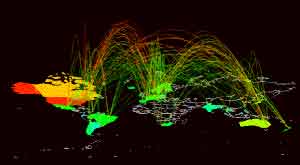
The virtual network of computers known as the “Information Highway”, is without a doubt one of the most important human achievements in the history of our planet. For better or worse, in the 25 years since then President George Bush decided to open to the public this technological tool, then limited to the army and a handful of scientists, internet has changed the world. But there was another human invention which linked two parts of the world as different as they are apart, an information and commerce highway that during its existence changed the history of civilization: the Silk Road.
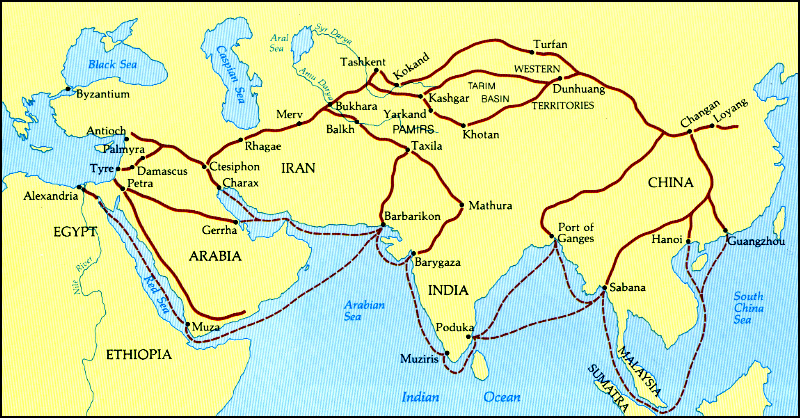
The origin of antiquity’s internet can be found in the II century before Christ, when the Chinese ruler Zhang Qian of the Western dynasty opened the first commercial route to Europe, which grew gradually during the reign of his descendants. Very important in the development of commerce were two campaigns against the Huns to eliminate obstacles and guarantee the safety of the caravans. In the year 60 b.C., the Han established a protectorate in Western China to control the roads even more.
To get some perspective, the set of ways and roads that became the internet of ancient times, extended for more than 6,000 kilometers, crossing desserts, mountain ranges and the vast steppes of Central Asia, from the coasts of China in the Pacific to
And, what did the merchants sold? Well, obviously, silk produced in China, a fabric which process of manufacture was a secret well guarded by the authorities, who also forbid the sale of the worm and its cocoons, the origin of the fiber. Silk was indeed a very

But then as now, products were not the only travelers of the highway which, for a reason, received the adjective “information”. The exchange of services and, mainly of ideas, had an even bigger impact than that of tangible assets. Agricultural or manufacturing

Large cities as Samarkand or Palmira acted as “servers”, where the information was stored to be shared later through the sand cables linking them to other “servers”. Users then sent data to other severs in the area. Markets were the search engines where, asking for the key word, anybody could find any product, data package or image available. Sadly, same as it occurs in modern networks, the Silk Road was the ideal vehicle to spread bugs, in this case the real kind, being the best known the Yersinia pestis (a bacteria), originated in China and responsible for more than 120 million deaths in Asia, Africa and Europe in the XIV century, the so-called Black Death.
At the end, the civilizations survived the ordeal and marched along History with new users, better anti-virus and more governmental control, but the Silk Road could not resist the attacks of a new network, by sea, where new bigger and faster ships left the internet of the camel, a thing of the past, just like Chrome making Explorer irrelevant. At the same time, the disintegration of the Mongol Empire divided the lands crossed by the road in unitary states, using gunpowder to solidify their power and to protect themselves from dangerous, foreign ideas. The deathblow came when in 1492, the Muslims lost their last possessions in Spain and launched a commercial boycott with Europe.
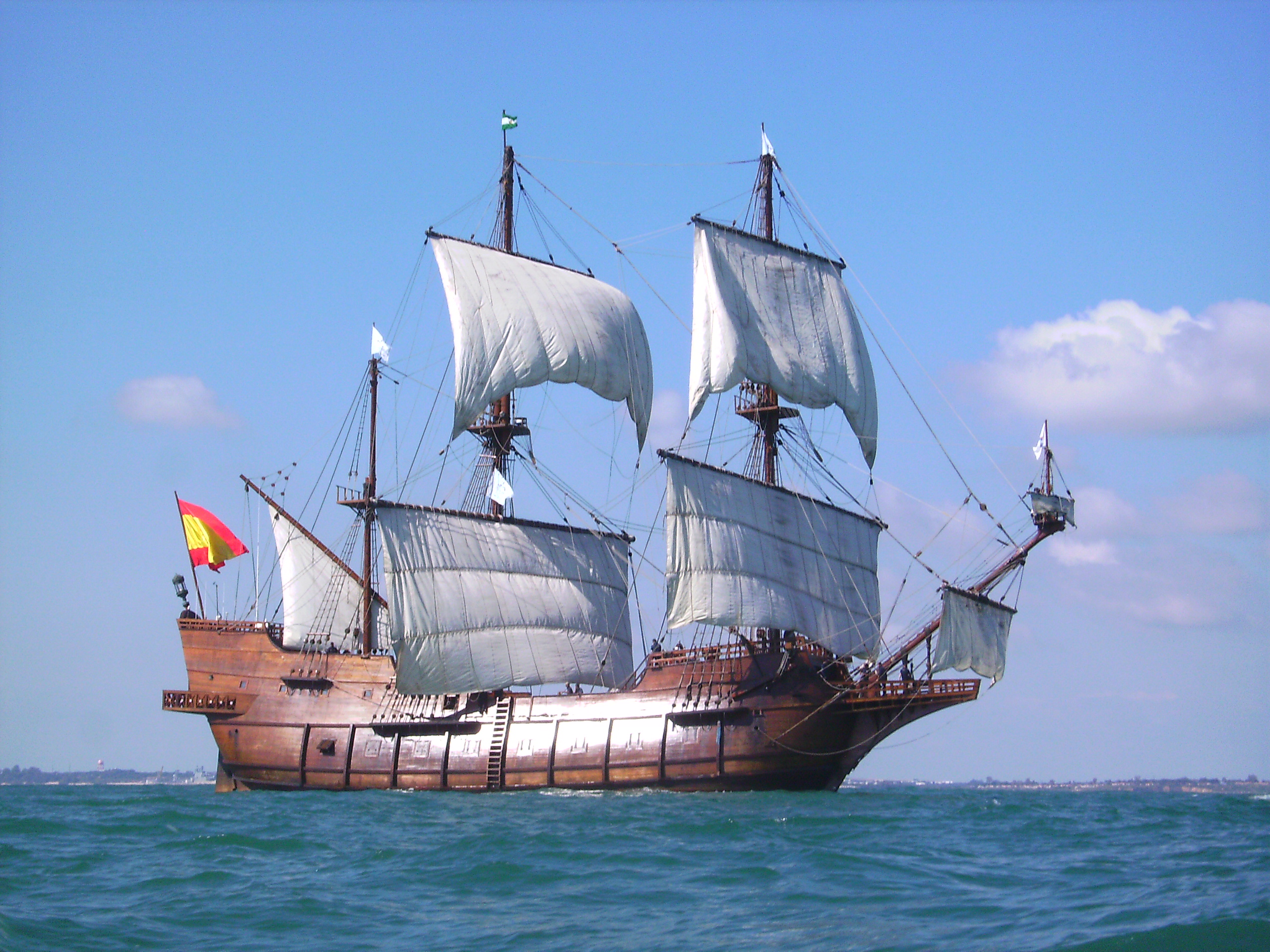
During more than 15 centuries the Silk Road was the most important means of cultural and commercial Exchange in the world. There were various attempts to bring it back to life during the Renaissance, but competition with the shipping lanes made it extremely expensive. That, at least until the end of the 20th century, when the cities of Chongqing in China and Duisburg, in Germany, were linked by a rail network that reduces the maritime shipping time by two thirds. China has rejoined the world and, to crown it all, while I write these lines the newspapers report that the Asian giant has become the world leader in electronic commerce. The Silk Road is back.